Conference Session Description Examples: Titles, Abstracts, and an Attendee-Facing Template
-1690817315934-652794559.png&w=96&q=75)
Benjamin Dell
Founder, HeySummit
A conference session description has a small job and a difficult one: help the right attendee decide whether a session deserves a place in their schedule. It is not a speaker biography, a proposal abstract copied into the agenda, or a string of broad benefits. The useful version names the audience, the problem they recognise, what will happen in the room, and what they can realistically take away.
This guide gives you six conference session description examples, a reusable writing template, and a practical editing process. It is written for organizers turning accepted proposals into public agenda copy, but speakers can use the same method before submitting their final text. If you are managing the full handoff, pair it with a speaker onboarding checklist so titles, descriptions, headshots, and approvals arrive together.
A conference session description template you can copy
Start with the session copy canvas below. Draft each field separately before combining it into prose. This stops an interesting topic from becoming a vague promise.
On a small screen, swipe across the table to see every column.
| Field | Question to answer | Your draft |
|---|---|---|
| Audience | Who is this specifically for? | [Role, experience level, or situation] |
| Problem | What are they trying to fix, choose, or understand? | [Recognisable problem or decision] |
| Promise | What useful progress will the session enable? | [One believable result] |
| Format | What will happen during the session? | [Talk, workshop, panel, demo, or discussion] |
| Evidence | What will make the advice credible? | [Example, data, case, demonstration, or framework] |
| Activity | What will attendees see or do? | [Compare, map, practise, draft, test, or discuss] |
| Takeaway 1 | What can they do after the session? | [Observable action] |
| Takeaway 2 | What can they decide or create? | [Observable action] |
| Constraint | What will the session not promise? | [Boundary, prerequisite, or limitation] |
| Next step | What can they use immediately? | [Worksheet, checklist, plan, or first action] |
Turn the completed canvas into a description with this pattern:
For [audience] who are dealing with [problem], this [format and duration] will [main session activity]. Using [evidence or method], we will [second activity or comparison]. You will leave able to [takeaway one] and [takeaway two], plus [practical next-step asset].
The pattern is a starting point, not a rigid formula. A keynote might lead with a tension or story. A workshop should say what attendees will practise or produce. A panel needs a clear question and a reason its mix of perspectives matters. The important thing is that the final copy answers the attendee's practical questions without making them decode internal event language.
Title, abstract, and attendee-facing description: what changes?
Organizers often receive one block of proposal copy and try to make it serve every purpose. That creates confusion because reviewers and attendees are making different decisions.
On a small screen, swipe across the table to see every column.
| Copy type | Primary reader | Its job |
|---|---|---|
| Session title | Attendee scanning an agenda | Signal the subject and useful angle in a few words. |
| Proposal abstract | Reviewer or programming team | Prove fit, substance, originality, and the speaker's plan. |
| Session description | Potential attendee | Explain who it is for, what will happen, and what the attendee can expect. |
A proposal abstract may include methodology, references, or evidence that helps a committee judge quality. The attendee-facing description usually needs plainer language and a more direct promise. Do not hide the useful part behind phrases such as “this session explores” or “join us for an insightful discussion.” Say what will be explored, why it matters, and what the session enables.
Event-specific requirements still matter. The current Heartland call-for-speakers guidance, for example, asks for a concise description alongside objectives, audience, experience, takeaways, and an engagement plan. The AAEM26 proposal guidance used a 300-word description limit and required measurable objectives. Treat those limits as part of the assignment, then adapt the accepted material for the public agenda.
The four-part test for useful session copy
Before you polish individual sentences, check the structure. A strong description passes four tests:
- Audience: A reader can tell whether the session is meant for them. “Marketing leaders planning their first multi-speaker event” is more useful than “anyone interested in events.”
- Problem: The copy names a situation the reader recognises. This can be a task, constraint, decision, or persistent source of friction.
- Activity: The reader knows what will happen. Will the speaker demonstrate a workflow, compare examples, facilitate practice, or moderate competing viewpoints?
- Takeaway: The reader can picture a realistic action after the session. Prefer “draft,” “compare,” “identify,” or “plan” to results the session cannot guarantee.
The Great Rivers Conference guidance on session objectives makes this distinction concrete: an objective such as identifying several revenue approaches is observable, while promising that attendees will increase revenue is not something a session can prove. That is a useful standard for every event format.
Before and after: from a topic to a decision-ready description
Before
Join us for an exciting session about repurposing webinars. We will share tips and best practices to help you get more from your content and reach a bigger audience.
What is missing: no defined audience, no session activity, no evidence, and no realistic takeaway. “Tips,” “best practices,” and “bigger audience” ask the reader to trust claims the copy has not earned.
After
For content leads with a finished webinar and no reuse plan, this 45-minute demonstration maps one recording into an article, an email sequence, and three social clips. We will compare what should stay live with what works better on demand, then build a two-week production plan. You will leave with a content map, a named owner for each asset, and one follow-up action you can start the same day.
Why it works: “content leads” defines the reader; “finished webinar and no reuse plan” names the situation; “demonstration,” “compare,” and “build” describe the activity; and the closing sentence promises concrete outputs without guaranteeing audience growth.
The revised version is longer, but length is not the main improvement. Each sentence earns its place by helping the attendee judge fit. If a short agenda card cannot hold the full version, keep the first and last sentences, then use the middle sentence on the session detail page.
Six conference session description examples
These examples are deliberately varied. Use their structure, not their subject matter, and keep the claims appropriate to your own speakers and evidence.
1. How-to talk: build a repeatable webinar promotion plan
Short agenda blurb: Build a four-week webinar promotion plan that connects speakers, email, partnerships, and social posts without relying on a last-minute burst.
Long description: For small event teams preparing a webinar or virtual summit, this 40-minute talk breaks promotion into four manageable weeks. We will map announcement, education, speaker amplification, and reminder activity to one shared timeline, then show where ownership usually becomes unclear. You will leave able to choose a channel role for each week, give speakers usable promotion windows, and draft the first version of your own plan.
- Audience: small event and content teams.
- Activity: map channels and ownership across a timeline.
- Takeaway: a first-draft promotion plan, not a promise of registrations.
2. Case-led talk: what changed after a weak first event
Short agenda blurb: See how one association rebuilt a confusing first-time attendee journey by tracing five real support questions back to the event setup.
Long description: New attendees rarely describe an event journey as a funnel. They ask where to start, whether they are registered, and how to find the next session. In this 30-minute case-led talk, an association event manager will walk through five recurring support questions from one event and the changes made before the next edition. Attendees will learn how to turn support themes into journey checks, separate copy problems from configuration problems, and choose one part of their own experience to test.
- Evidence: a bounded case with actual support themes.
- Activity: trace questions to journey points and compare fixes.
- Boundary: the example informs a method; it does not claim every event has the same causes.
3. Workshop: turn speaker ideas into attendee-facing copy
Short agenda blurb: Bring one accepted session idea and leave with a clearer title, agenda blurb, and two realistic attendee takeaways.
Long description: For organizers and speakers with accepted topics that still read like proposal abstracts, this 60-minute workshop turns internal submission copy into an attendee-facing title and description. After a short demonstration, you will use the audience-problem-activity-takeaway test on your own draft, exchange feedback with a partner, and revise the promise. Bring one accepted topic. You will leave with an agenda-ready blurb, a longer detail-page version, and two outcomes the session can genuinely support.
- Format: workshop, with a stated prerequisite.
- Activity: draft, review, and revise.
- Takeaway: named pieces of copy attendees can finish in the room.
4. Panel: where hybrid events still create friction
Short agenda blurb: Three event leaders compare the decisions that helped remote and in-room attendees participate in the same programme.
Long description: Hybrid event advice often stops at equipment. This 45-minute panel focuses on programme decisions: how to design questions for two audiences, when to split activities, and how to communicate what remote attendees can actually do. A corporate producer, an association organizer, and a community host will compare one decision each that worked and one they would change. You will leave with four questions for reviewing a hybrid session and a clearer way to set participation expectations.
- Panel question: how to make participation expectations honest and workable.
- Perspective mix: each role is named and contributes a different operating context.
- Takeaway: review questions rather than a claim that one format fits all.
5. Product demonstration: manage speaker details without email chasing
Short agenda blurb: See how a shared speaker workflow can collect profiles, session details, media, and approvals while organizers keep control of final publishing.
Long description: For event teams still assembling speaker information across inboxes and spreadsheets, this 25-minute product demonstration follows one invited speaker from first request to agenda-ready session. We will show which details a speaker can maintain, where the organizer reviews public copy, and how to spot missing assets before launch. You will leave with a field checklist for your own process and a clearer division of responsibility between speakers and the event team.
- Product context: the workflow is shown, not hidden behind a broad efficiency claim.
- Activity: follow one bounded journey from invitation to review.
- Takeaway: a checklist and ownership model.
6. Executive keynote: make fewer event metrics carry more weight
Short agenda blurb: Reframe event reporting around the decisions leaders need to make, then choose a small set of measures that can support those decisions.
Long description: Dashboards can grow faster than confidence in the story they tell. In this 35-minute keynote, a portfolio marketing leader will examine three decisions event reporting should support: where to invest, what to repeat, and what to stop. Using examples from registration, attendance, and follow-up, the session will show how context changes the meaning of a metric. You will leave able to connect one measure to one decision, identify a misleading comparison, and frame a more useful question for your next review.
- Tension: more metrics do not automatically create better decisions.
- Evidence: examples across three stages of the event journey.
- Outcome: clearer questions and comparisons, not guaranteed executive buy-in.
Write short and long versions without changing the promise
An agenda card and a detail page can use different lengths, but they should not describe different sessions. The short version keeps the minimum information required for a scheduling decision. The long version adds evidence, activity, format, and secondary takeaways.
Use this order when shortening:
- Keep the audience or recognisable situation.
- Keep the central problem and main promise.
- Keep the format when it changes the attendee's expectation.
- Keep one concrete takeaway.
- Move secondary examples, credentials, and process detail to the full page.
Do not shorten by replacing specifics with adjectives. “A practical, engaging, transformative session” uses space without helping anyone choose. “Compare three onboarding emails and rewrite one of your own” is shorter and more informative.
Adapt the description to format and duration
The same topic should be described differently when the experience changes.
- Talk: name the argument, evidence, or framework the speaker will present. Avoid implying hands-on work if attendees will mainly listen.
- Workshop: state the prerequisite, activity, and output. If attendees need a laptop, draft, account, or dataset, say so before registration.
- Panel: identify the central question and why the panel composition adds useful contrast. A list of names is not a session description.
- Keynote: make the tension and perspective clear, then keep the takeaway credible for a broad audience.
- Demonstration: say what will be shown, whose workflow it represents, and what viewers can evaluate afterwards.
Duration changes the credible scope. A 20-minute talk can explain one model and one example. A 90-minute workshop can include practice and feedback. If the copy lists seven outcomes for a short slot, narrow the promise or make the activities explicit. Your conference agenda plan should give each session enough time to fulfil the expectation its description creates.
An organizer workflow for editing speaker submissions
Editing accepted copy should improve clarity without quietly changing the speaker's meaning. Use a named owner, visible deadlines, and one final approval point.
- Preserve the source. Keep the submitted title, abstract, and objectives available so editors can check substantive changes.
- Standardize the brief. Give every session the same limits for title length, short description, long description, audience label, and outcomes.
- Edit for the attendee. Remove internal proposal language, expose the activity, and replace unprovable claims with realistic actions.
- Ask about meaning, not punctuation. Speaker review matters when an edit changes the claim, example, activity, or expected outcome.
- Freeze the public version. Set a date after which material changes need an organizer's approval, especially once promotion has started.
A shared speaker dashboard gives speakers one place to maintain their public information while the organizer keeps a consistent review process. That is more reliable than asking people to find the latest attachment in an email thread.
Check the whole agenda, not only each session
A clear description can still fail inside a confusing agenda. Read the programme as a set and look for collisions:
- Several titles begin with the same empty phrase, such as “The future of”.
- Different sessions promise the same takeaway without explaining the distinction.
- Beginner and advanced sessions use similar language but no experience labels.
- Panels, workshops, and demonstrations are not identified, so attendees cannot plan how they want to participate.
- Descriptions refer to internal tracks, acronyms, or submission categories that attendees have not seen.
- Short agenda blurbs make stronger promises than the longer descriptions.
Then read the agenda on a phone. Check whether titles still make sense when truncated, whether filters use attendee language, and whether a person can compare two sessions without opening several tabs. This whole-programme pass is where consistent length and audience labels become valuable.
Put approved session copy into HeySummit
Once the wording is approved, organizers can centralise speaker and session management in HeySummit. Speakers can review their assigned session details in their dashboard, while organizers retain control of the wider event programme. You can see the broader flow in the HeySummit product tour.
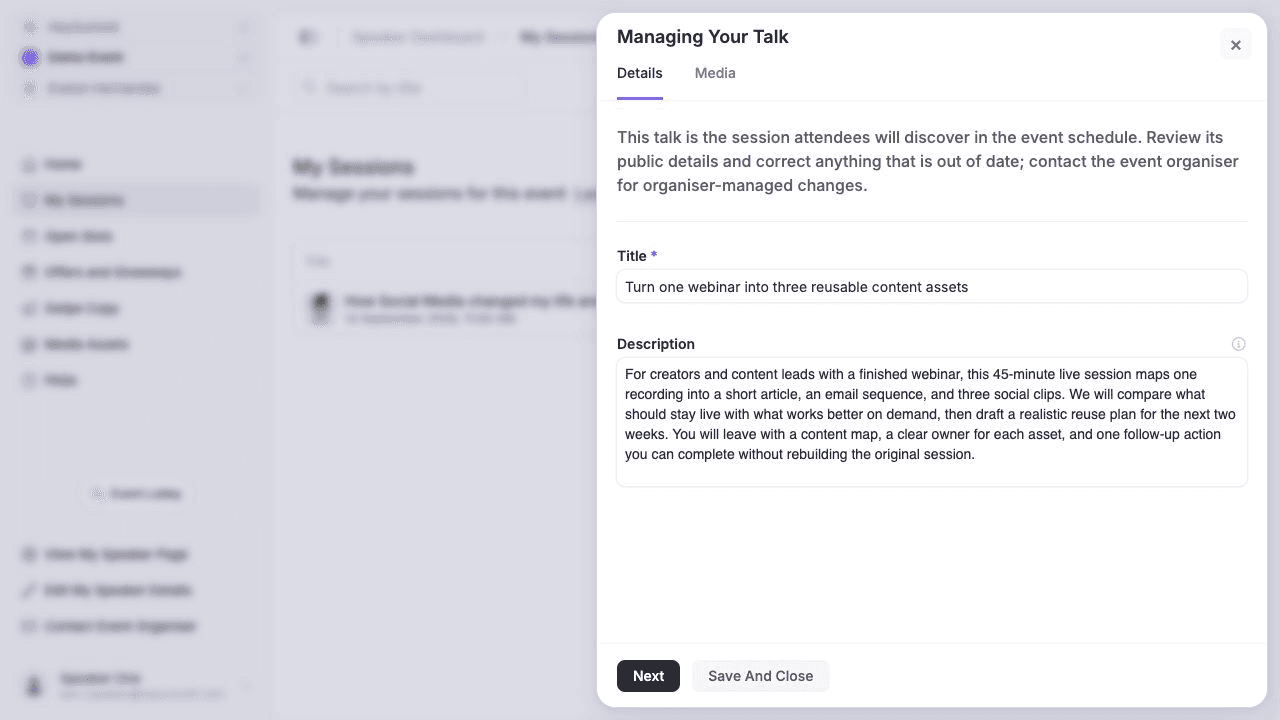
The tool should support the editorial process, not replace it. Decide your audience labels, length limits, review owner, and approval deadline before inviting a large speaker group. Then configure the workflow around those decisions. This makes it easier for speakers to supply usable information and for organizers to keep the public agenda consistent.
Final conference session description checklist
Before a session goes live, confirm that:
- the title names a subject and useful angle;
- the description identifies an audience or recognisable situation;
- the problem or decision is concrete;
- the format matches what will happen;
- the activities use specific verbs;
- the outcomes are realistic and observable;
- the short and long versions make the same promise;
- the speaker has approved material changes;
- the copy follows the event's stated word or character limits; and
- the agenda makes experience level, prerequisites, and participation expectations clear where needed.
The quickest improvement is usually to replace one vague benefit with one visible activity and one believable takeaway. Do that across every accepted session, then review the full agenda for consistency. Attendees will have a clearer basis for choosing, and your team will have copy that is easier to publish, promote, and keep current.
Frequently asked questions
Table of Contents
A conference session description template you can copyTitle, abstract, and attendee-facing description: what changes?The four-part test for useful session copyBefore and after: from a topic to a decision-ready descriptionSix conference session description examplesWrite short and long versions without changing the promiseAdapt the description to format and durationAn organizer workflow for editing speaker submissionsCheck the whole agenda, not only each sessionPut approved session copy into HeySummitFinal conference session description checklistFrequently Asked QuestionsTry HeySummit free
HeySummit is the easiest way for creators and educators to grow their audience, authority and revenue with professional online events created in minutes, not weeks.
Share this article on:
Recent Posts
Loading feed...