How to Get Event Sponsors for Online and Hybrid Events
-1690817315934-652794559.png&w=96&q=75)
Benjamin Dell
Founder, HeySummit
Weak sponsorship outreach often begins with a famous company name, a generic deck, and a request for money. Strong outreach starts one step earlier: with evidence that the company, the audience, and an activation genuinely fit.
This playbook gives you a practical route from audience research to a qualified sponsor conversation. You will build a smaller prospect list, score it consistently, choose a responsible contact path, structure the first message, and hand a qualified opportunity into package and proposal work.
How to get event sponsors: the quick answer
Use this eight-stage workflow:
- Define the audience and assets you can prove.
- Find plausible companies through warm relationships and relevant public sources.
- Score sponsor fit using evidence rather than brand recognition.
- Choose the right contact path and identify a relevant role.
- Start a fit conversation with a specific, honest first message.
- Qualify the opportunity before promising deliverables.
- Build the package and proposal around what you learned.
- Deliver and report through an event workflow your team can operate.
This article goes deepest on the first six stages. Once a prospect is qualified, use your event sponsorship ideas, package, proposal, and reporting documents to turn the conversation into a realistic offer.
Prepare the minimum evidence before you build a list
A company cannot judge fit if your event is still described as “a great opportunity for exposure.” Prepare a small evidence pack before researching prospects:
- Event promise: the problem the event helps attendees solve and the format you will use.
- Audience: roles, interests, geography, level of experience, and the evidence behind those assumptions.
- Useful activations: things a sponsor could contribute that improve the attendee experience, not just logo placements.
- Proof: prior event results, community signals, speaker or partner credibility, owned reach, or an honest statement that this is a new event.
- Measurable delivery: the placements, links, sessions, assets, or opt-in actions you can report without promising downstream revenue.
- Ownership: one person responsible for the relationship, approvals, assets, delivery, and reporting.
Do not turn forecasts into facts. If you have no reliable attendance history, say so and explain what you can deliver and measure instead.
Build a sponsor-fit scorecard
Sponsor fit means there is a credible connection between the company, the audience, the event, and an activation your team can deliver. Budget and brand size do not prove that connection. A meta-analysis of sports sponsorship research found a consistent relationship between perceived event-brand fit and consumer responses. That is useful directional support for testing fit, not a promise about the outcome of your online, hybrid, or in-person event.
On a smaller screen, swipe sideways to read every scorecard column.
| Criterion | Evidence question | 0 | 1 | 2 |
|---|---|---|---|---|
| Audience overlap | Does the company already serve or want to reach this audience? | No evidence | Broad overlap | Direct, evidenced overlap |
| Problem relevance | Is its product, service, or mission relevant to a real attendee problem? | Unrelated | Adjacent | Clearly relevant |
| Event-brand congruence | Would the association make sense to attendees? | Confusing | Plausible | Natural fit |
| Attendee usefulness | Can the sponsor add value without interrupting the event? | No useful role | Generic benefit | Specific useful contribution |
| Activation | Can you name one credible way the sponsor could participate? | Logo only | Early idea | Clear testable idea |
| Proof available | Can you support the audience and delivery claims you will make? | No proof | Partial proof | Relevant evidence ready |
| Relationship path | Is there a warm introduction or appropriate public business route? | No responsible route | Public route | Relevant warm path |
| Delivery and evidence | Can your team fulfil the idea and report what happened? | Not feasible | Needs work | Owner, assets, and evidence defined |
For example, an education summit might score a complementary software company highly because it already serves course creators, can teach a useful workflow, has a relevant partner contact, and can provide a practical attendee resource. The same company should score poorly if its proposed activation is simply collecting attendee details without clear consent.
Add knockout checks outside the total. Decline or pause a prospect when there is a values or brand-safety conflict, an exclusivity conflict, an impossible deliverable, unclear data-sharing expectations, or no lawful and responsible contact route.
Where to find potential event sponsors
Start where you already have context. A shorter list built from real relationships and audience evidence is more useful than an evergreen directory of famous brands.
- Your existing network: customers, members, speakers, partners, vendors, advisors, board members, and community leaders may know relevant companies or be able to introduce you.
- Adjacent brands: look for companies that already sell to, educate, employ, or partner with your audience.
- Comparable events: review sponsors of events with a genuinely similar audience. Treat this as evidence of category interest, not permission to copy their package.
- Audience ecosystems: relevant associations, newsletters, podcasts, communities, local suppliers, and professional groups can reveal natural partner categories.
- Public sponsorship routes: use company sponsorship pages, partnership forms, directories, and marketplaces as discovery aids when their criteria match your event.
Avoid scraped personal details, bought lists, and static “100 companies that sponsor events” posts. They create a large research queue without telling you why any company should care about this event.
Create a prospect tracker your team can operate
Your tracker should answer three questions at a glance: why the company fits, who owns the next action, and whether contact should continue.
On a smaller screen, swipe sideways to read every tracker field.
| Field group | Fields to record | Why it matters |
|---|---|---|
| Fit | Company, fit hypothesis, audience overlap, evidence URL, likely sponsor goal | Stops a name from entering the list without a reason |
| Activation | Value hypothesis, activation idea, proof available, delivery constraints | Connects outreach to something your event can actually deliver |
| Contact | Warm path, public contact source, relevant role, contact owner | Keeps research targeted and accountable |
| Progress | Stage, last action, next action, next-action date, notes | Prevents duplicate messages and lost follow-up |
| Suppression | Objection, opt-out, do-not-contact status, reason, date | Makes stopping contact part of the workflow |
Useful stages include Researching, Qualified, Intro requested, Contacted, Conversation, Package requested, Proposal, Won, Lost, Not now, and Do not contact. A small team can begin with a spreadsheet or its existing CRM; the operating discipline matters more than the software.
Find the right person and contact route
The relevant role depends on the company and the activation. It may sit in partnerships, field or event marketing, community, brand, demand generation, alliances, or local marketing. In a smaller company, the founder or owner may be the appropriate contact.
Prefer a relevant introduction or a public business contact route. Use professional networks to understand role relevance, not to harvest personal details for bulk outreach. If the company publishes sponsorship criteria, a partnership form, or an application route, follow that process.
Structure the first outreach as a fit conversation
The first message does not need to carry your full sponsorship package. Its job is to show that you did the work and make it easy to decide whether a conversation is worthwhile.
- Subject: name the event or audience relevance honestly.
- Context: explain the warm connection or why you chose this company.
- Fit: give one specific reason its work connects to the audience.
- Value hypothesis: suggest one tentative activation that could help attendees and support a sponsor objective.
- Proof: share one relevant fact you can support, or state clearly that this is a new event.
- Next step: ask for a short fit conversation, not approval of an untailored deck.
- Sender and choice: include accurate identity and contact details plus the opt-out or other compliance elements appropriate to the recipient and jurisdiction.
Weak: “We have exciting sponsorship opportunities and would love to partner.”
Stronger: “Your training for independent course creators overlaps with the audience for our online education summit. Would you be open to a short conversation about a practical attendee clinic rather than a standard logo package?”
A one-page overview can help when the prospect needs basic event, audience, timing, and organizer context. Build the detailed package or proposal after you understand the sponsor's objective, approval process, and constraints.
Follow up without turning outreach into spam
Use a short, finite sequence. Every follow-up should add useful context, answer a likely question, or close the loop. Do not invent a universal day count or continue indefinitely because the tracker still says “open.”
Rules vary by recipient and jurisdiction, so this is an operating guardrail rather than legal advice. The FTC's CAN-SPAM guidance explains that US commercial-email rules also apply to B2B messages and require accurate sender information, honest subject lines, a valid postal address, a working opt-out, and prompt handling of opt-outs. The ICO's B2B marketing guidance distinguishes corporate subscribers from sole traders and other individual subscribers, while noting that named business-contact data can still fall under UK GDPR.
The ICO page is currently marked as under review following legal changes. Check the rules that apply to your situation, respect objections and opt-outs, and keep an accurate suppression list. When you are uncertain about the recipient type or your legal basis, get appropriate advice before sending.
Qualify the opportunity before you build a package
A positive reply is permission to learn, not permission to promise. Use the conversation to understand:
- the audience or business objective the sponsor cares about;
- timing, budget process, approval owner, and brand or legal review;
- the activation and deliverables that would be useful;
- category conflicts, exclusivity, and competitor restrictions;
- data, consent, and follow-up expectations;
- which evidence would help the sponsor evaluate delivery or consider renewal;
- what your team cannot responsibly offer.
Then choose a branch: progress a good fit now, nurture a plausible future fit, suggest a different package, or decline because the event cannot deliver the requested value responsibly.
Adapt the offer to the event format
Creator or education online summit
A relevant software or education partner might contribute a practical session, resource, office hour, or opt-in offer for a tightly defined audience. Keep attendee consent and sponsor follow-up boundaries explicit. Replays and dedicated sponsor destinations can extend access, but they do not prove sponsor ROI.
Community event
A smaller community can be attractive because its members share a clear interest or professional identity. Lead with relevance, participation quality, and useful contribution—not inflated audience size. A sponsor-supported scholarship, member resource, or expert clinic may fit better than broad branding.
Hybrid professional event
Separate online and venue delivery. Define digital destinations, sessions, replays, links, and opt-in actions alongside physical signage, staffing, booth requirements, and onsite assets. Decide how online and in-person evidence will be reported before the package is signed.
Hand a qualified sponsor into package, proposal, and delivery
Once fit is confirmed, translate the conversation into a deliverable plan:
- Choose activation options from your event sponsorship ideas.
- Use a sponsorship package worksheet to define tiers or modular deliverables.
- Tailor an event sponsorship proposal after discovery.
- Agree the objective, audience, activation, owner, assets, approvals, dates, measurement, and reporting promise.
- Use a sponsor deliverables and reporting checklist before commitments are finalized.
Do this before the event team begins publishing sponsor assets. It is much easier to prevent an impossible promise than to repair one after the sponsor has signed.
Where HeySummit fits—and where it does not
HeySummit helps with the event-delivery side after you have identified and qualified a sponsor. Organizers can add sponsor details, control placements, enable a dedicated booth where available, add media, optionally enable chat, and invite sponsor contacts to manage booth information through their own access.
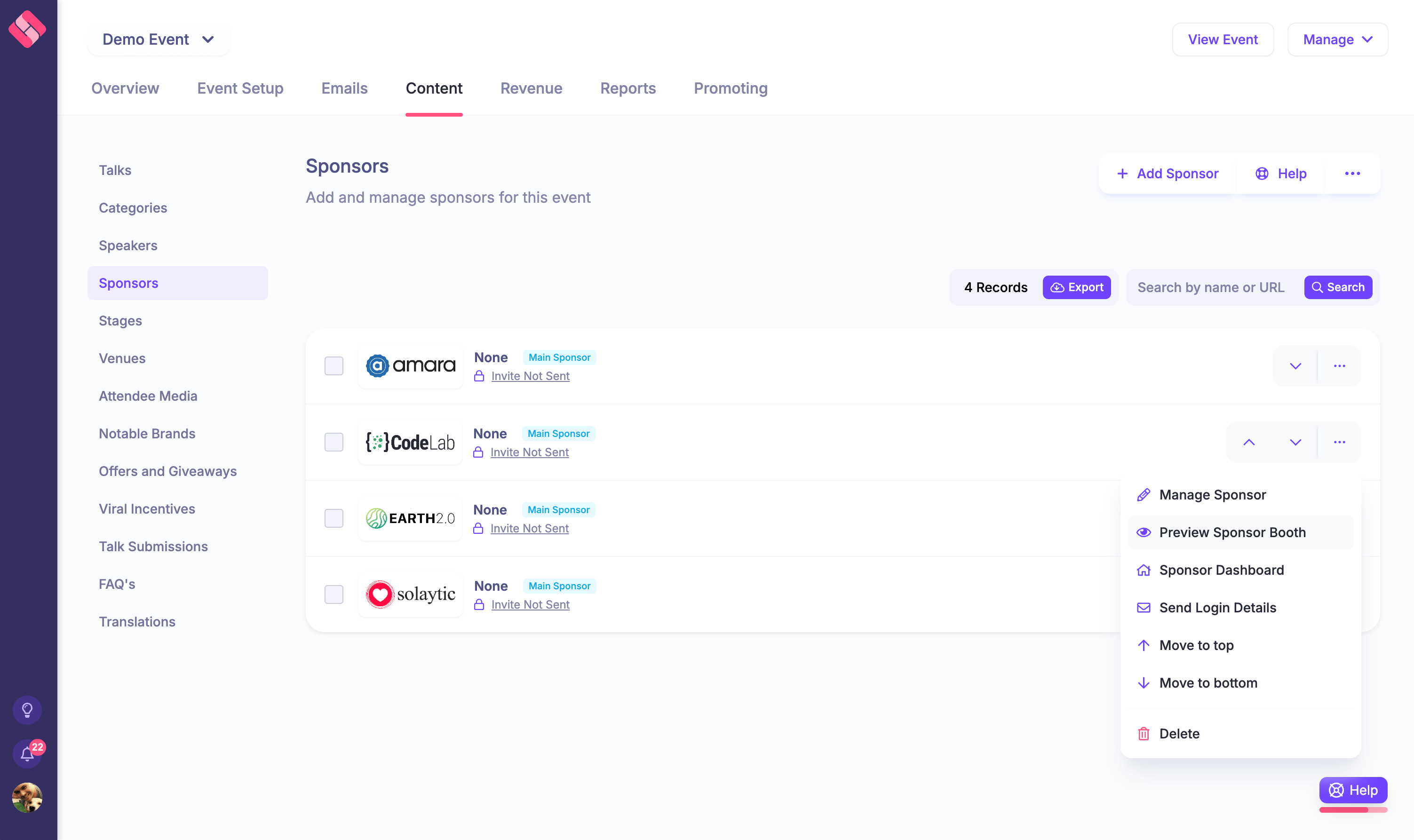
HeySummit is not a sponsor marketplace, prospect database, outreach automation tool, contract system, or sales CRM. It does not guarantee sponsor leads, responses, or ROI. Its job is to help you manage sponsor visibility and delivery as part of the wider event workflow.
Explore HeySummit's sponsor booths and placement controls, or see how the wider HeySummit workflow fits together.
Start with five plausible companies
Do not begin with a list of one hundred logos. Choose five companies with a plausible audience connection, record the evidence, score them, and contact only the strongest fit first. Use the conversation to improve your assumptions before you expand the list.
The goal is not more outreach. It is a smaller number of relevant, responsible conversations that your event team can turn into useful sponsor experiences and deliver without overpromising.
Frequently asked questions
Table of Contents
How to get event sponsors: the quick answerPrepare the minimum evidence before you build a listBuild a sponsor-fit scorecardWhere to find potential event sponsorsCreate a prospect tracker your team can operateFind the right person and contact routeStructure the first outreach as a fit conversationFollow up without turning outreach into spamQualify the opportunity before you build a packageAdapt the offer to the event formatHand a qualified sponsor into package, proposal, and deliveryWhere HeySummit fits—and where it does notStart with five plausible companiesFrequently Asked QuestionsTry HeySummit free
HeySummit is the easiest way for creators and educators to grow their audience, authority and revenue with professional online events created in minutes, not weeks.
Share this article on:
Recent Posts
Loading feed...