Event Partnerships: How to Choose, Pitch and Run Mutually Useful Collaborations
-1690817315934-652794559.png&w=96&q=75)
Benjamin Dell
Founder, HeySummit
Event partnerships often begin with an exciting idea and a vague promise to "promote each other." The trouble starts later, when nobody knows which audience the partnership should help, who owns the landing-page copy, or what either side will count as a useful result.
A workable partnership is much more specific. It gives one partner a clear job, defines a fair exchange, assigns each deliverable to a person and sets the data and disclosure boundaries before promotion starts. This guide gives you a partner-type matrix, a seven-point fit check, a one-page plan, a delivery calendar and a simple way to decide whether to repeat the partnership.
What an event partnership actually is
An event partnership is a time-bounded exchange between an organiser and another party around a specific event goal. Each side contributes something defined, such as content, funding, distribution, technology, a venue or a better attendee experience. Each side also receives something agreed in advance.
That definition is deliberately narrower than "working together." A sponsor pays or contributes goods and services for an agreed return. An affiliate earns commission for tracked referrals. A speaker contributes expertise. A venue or technology provider delivers a service. A community or media partner may contribute distribution, credibility or programming. One organisation can fill more than one role, but each role still needs its own terms, owner and measure.
Choose the partner's job before you choose the organisation. "We need more reach" is not a useful brief. "We need trusted introductions to independent course creators who run paid workshops" gives you an audience, a contribution and a reason to talk to a particular community.
On a phone, swipe sideways to compare every column in the partner matrix.
| Partner type | Main contribution | Fair return | Primary owner | Evidence to collect | Common failure |
|---|---|---|---|---|---|
| Speaker or content partner | Expertise, a session, workshop or useful event material | A well-run appearance, relevant exposure, reusable assets or an agreed fee | Programme or speaker lead | Approved session, assets delivered, attendee feedback and agreed promotion | Treating audience promotion as an unwritten condition of speaking |
| Sponsor | Funding, services, prizes or production support | Defined visibility, content involvement or attendee interactions | Sponsorship lead | Placements delivered, agreed interactions and fulfilment notes | Selling a logo package with no attendee value or delivery plan |
| Affiliate or referral partner | Tracked registrations or sales from their audience | Commission, reciprocal referral value or another stated reward | Growth or affiliate lead | Tracked link activity, eligible outcomes, commission and disclosures | Using shared links without attribution rules or a disclosure plan |
| Community partner | Audience access, co-created programming or member insight | Useful member content, visibility, access or reciprocal support | Community lead | Approved sends, participation quality and member response | Borrowing the audience without creating clear member value |
| Media partner | Editorial coverage, newsletter distribution or interviews | A relevant story, access, content or a commercial package | Communications lead | Confirmed placements, sends, referrals and editorial boundaries | Assuming coverage before the outlet agrees the story |
| Venue, technology or delivery partner | Space, systems, production or specialist delivery | Fees, visibility, referrals or a defined service exchange | Event operations lead | Service levels, readiness checks, incidents and completion | Confusing procurement with a promotional partnership |
Score the fit before you make the pitch
A familiar name or a large mailing list can distract you from a poor fit. Score the proposed partnership against the work it needs to do. Use 0 for a clear problem, 1 for unknown or weak evidence, and 2 for a strong, evidenced fit.
- Audience overlap. Does the partner reach people who genuinely match this event, without relying on a broad demographic label?
- Goal fit. Can the partner make the chosen event outcome more likely through a contribution they can control?
- Trust and reputation. Would their involvement help the attendee, and can both brands stand behind the association?
- Contribution quality. Is the proposed content, funding, distribution or delivery concrete enough to assess?
- Delivery capacity. Does the partner have an owner, time and approval route for the work?
- Internal burden. Can your team support the relationship without displacing more important event work?
- Disclosure and data risk. Can you explain the commercial relationship and any data use plainly, with suitable review?
The total is a prompt for a better conversation, not a universal benchmark. Any zero on attendee value, reputation, delivery capacity or data handling is a reason to stop and investigate. Walk away when the value remains one-sided, the partner wants data without a valid plan, or nobody can own the promised work.
A field study of sponsor-event fit supports the common-sense emphasis on fit, but keep its limits in view. It examined a title sponsor at a professional cycling event, so it does not prove that every community, speaker or media partnership will perform. The useful conclusion is modest: check whether the partnership makes sense to the audience before you negotiate reach or price.
Put the value exchange on one page
You do not need a long proposal to discover whether the partnership is workable. Start with a one-page plan that both sides can correct before it becomes an agreement. Record:
- the event goal and the partner's specific job;
- what the organiser contributes and what the partner contributes;
- the benefit for attendees, not only the benefit for both organisations;
- one named owner for every deliverable;
- dates, assets, formats and approval rights;
- promotion channels and any disclosure requirement;
- what personal data, if any, each side needs and the legal basis for using it;
- the primary outcome, delivery checks and any baseline;
- the escalation route if something slips; and
- the closeout date and the rule for renewing, changing or ending the partnership.
This page is an operating brief, not a substitute for a contract or legal review. The agreement may need more detail about payment, intellectual property, cancellation, liability, confidentiality, privacy or jurisdiction. The one-page plan makes those questions visible early enough to resolve them.
A six-step partnership workflow
- Name the goal and missing contribution. Decide what the event needs before building a prospect list.
- Check the fit. Test the audience, contribution, capacity, burden and risks.
- Agree the exchange. Define what each side gives, receives and approves.
- Assign the work. Put every asset and action against an owner and date.
- Promote and deliver. Use the approved messages, links, event surfaces and fulfilment plan.
- Review the result. Compare the agreed outcome with delivery evidence, then renew, change or close.
Pitch in the order that reduces uncertainty
A good pitch is the result of useful research, not a clever opening line. First, understand the partner's audience, current priorities and ability to contribute. Send a short note that connects one event goal to one plausible partner job. Ask for a discovery conversation before presenting a finished package.
During that conversation, test the value exchange and the internal work each side must absorb. Follow with the tailored one-page plan. Only then move to agreement and kickoff. If you are approaching sponsors, use a deliberate process to build and qualify a sponsor prospect list, then adapt an event sponsorship proposal template to the opportunity. Keep the partnership guide focused on the operating model rather than sending every relationship through a sponsor-sales script.
Turn the agreement into a delivery calendar
The moment both sides agree the shape of the partnership, translate it into dated work. Give every deliverable one owner and keep the current status in one shared place. A partner can contribute, review or approve, but one person still needs to be responsible for moving the item forward.
On a phone, swipe sideways to see the owner, deadline and proof columns.
| Deliverable | Owner | Partner role | Due point | Proof of completion |
|---|---|---|---|---|
| Event-page copy and partner assets | Event marketing lead | Supply and approve named assets | Before registration opens | Approved page preview and final files |
| Tracked links and disclosures | Growth lead | Confirm channels and required wording | Before any promotion | Tested links and approved message set |
| Speaker, sponsor or affiliate setup | Event operations lead | Complete assigned profile or access steps | Before the promotion window | Ready status in the event workflow |
| Live or on-demand fulfilment | Programme lead | Deliver agreed session, offer or service | Event day or access period | Delivery record and issue notes |
| Report and closeout | Partnership owner | Review results and confirm open obligations | Agreed post-event date | Shared review and renewal decision |
For a busy programme, connect this calendar to your wider event communication plan. It helps prevent the partnership schedule from drifting away from attendee emails, speaker deadlines and event-page changes.
Operate each partner type on its own terms
Speaker and content partners
Define the content contribution, format, deadlines, review rights and promotion request separately. Speaking should not quietly become a compulsory audience-rental deal. Give participants a clear preparation route and reusable approved assets. A speaker dashboard can keep profiles, talk details and participation tasks together, while a speaker promotion kit gives willing speakers consistent copy and creative.
Sponsors
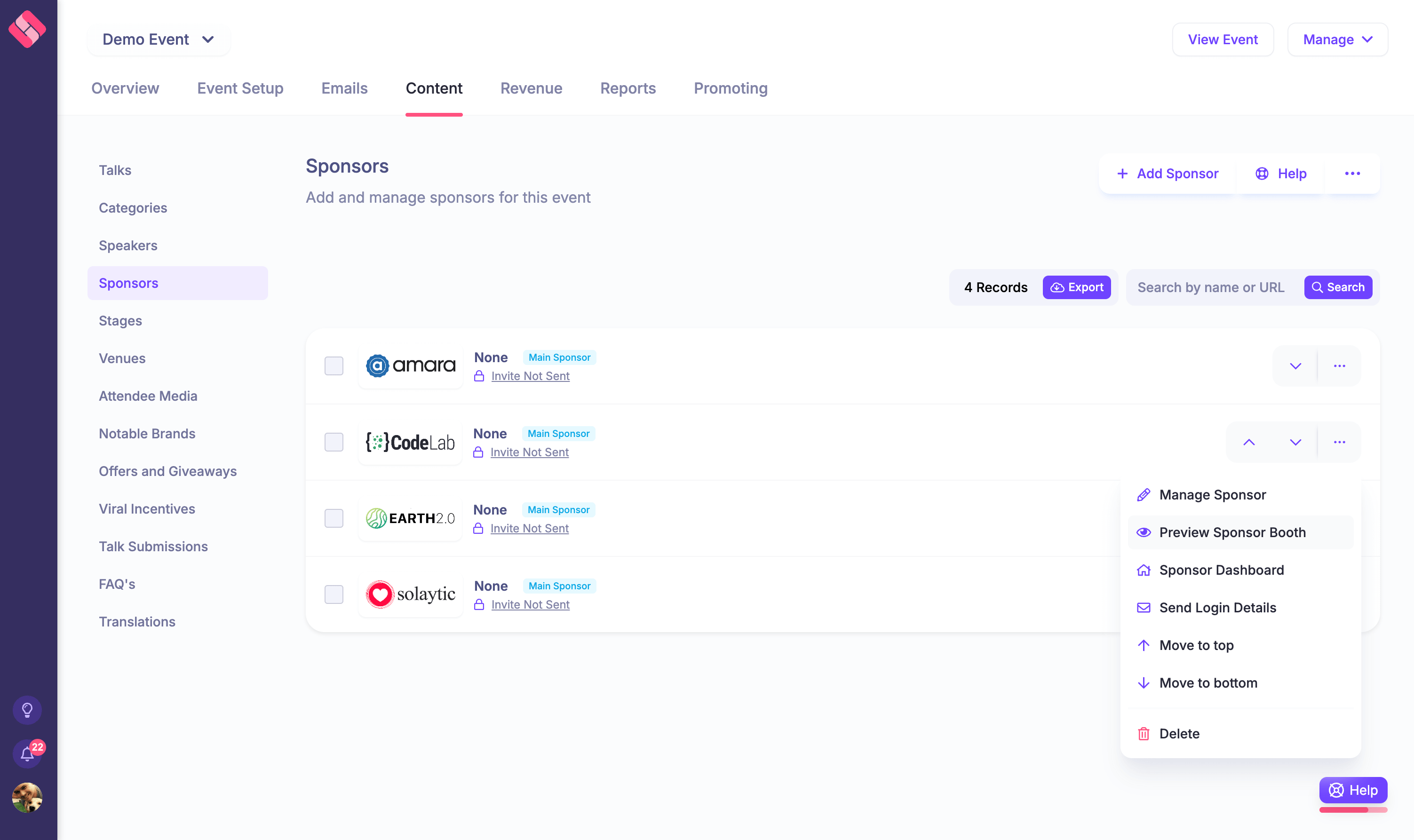
Write down the placement, content, interaction and fulfilment promised at each level. Separate exposure that you can deliver from outcomes that you cannot guarantee. In HeySummit, sponsor pages and placement controls can support the sponsor's presence inside the event experience. The organiser still owns the commercial agreement, approvals and any separate lead-sharing decision.
Affiliate and referral partners
Define the eligible outcome, attribution window, commission or reward, payout process and disclosure responsibility. Test every link before sharing it. HeySummit's affiliate tracking for event partners supports referral setup and performance tracking when the relationship is genuinely an affiliate arrangement. Use the full event affiliate programme guide when commission design and partner onboarding need more depth.
Community and media partners
Agree the audience benefit, editorial boundary, channel, send or placement date, assets and any reciprocal promotion. A newsletter mention, co-hosted session and editorial interview are different deliverables. If promotion runs through connected external tools, review the relevant event marketing integrations, but keep the partner's own channel execution with that partner.
Venue, technology and delivery partners
Separate service delivery from promotion. Name the specification, readiness checks, support contact, escalation route and evidence that the service worked. If the provider also receives visibility or referrals, write that as a second role with its own value exchange.
Handle promotion, disclosures and attendee data before launch
A partner relationship can change how an audience interprets a recommendation. The FTC's Endorsement Guides say a material connection that could affect how people assess an endorsement should be disclosed clearly and conspicuously. Paid, gifted and commission-based promotion may all need attention. The exact requirement depends on the message, relationship, audience and jurisdiction, so ask for appropriate review.
Attendee data needs its own decision. Shared goals do not create consent, and a partnership does not automatically give either side the right to an attendee list. The ICO's direct-marketing guidance says organisations should be clear about the information they need, the purpose, the lawful basis and who is responsible when they work with others. It also says organisers should tell people about direct-marketing data sharing and keep records of what they decided, collected and communicated.
Before registration opens, decide who collects each piece of information, what notice attendees see, which organisation may use it, for which purpose, for how long and how people can exercise their rights. If a sponsor only needs an aggregate fulfilment report, do not share personal data out of habit.
Measure the result you agreed
Start with one primary outcome tied to the partner's job. Add a few delivery checks that show whether both sides did what they promised. Do not force every relationship into a return-on-investment calculation. A speaker's useful session, a vendor's reliable delivery and a sponsor's agreed placements need different evidence.
On a phone, swipe sideways to compare the review decisions.
| Partner job | Primary outcome | Delivery checks | Review decision |
|---|---|---|---|
| Affiliate distribution | Eligible tracked registrations or sales | Links worked, disclosures appeared and payouts reconcile | Keep, change the offer or close the relationship |
| Sponsor presence | Agreed interactions or another defined package outcome | Placements, assets and fulfilment delivered | Renew, redesign the package or stop selling it |
| Speaker contribution | Completed useful content | Preparation, delivery and attendee feedback | Invite again, adjust the format or close |
| Community or media distribution | Verified send, placement or referral activity | Message approved, date met and source tagged | Repeat, test another channel or stop |
| Venue or delivery service | Service delivered to the agreed standard | Readiness, incidents, response and completion | Retain, change the scope or replace |
Compare the result with whatever baseline you agreed and add qualitative notes where the numbers miss important context. A community partner might send fewer registrations than expected but reveal a strong audience fit. A sponsor package might hit every placement deadline but create more admin than the value justifies. Record both.
Worked example for a small paid online summit
Imagine a small organiser running a paid online summit for independent course creators. The aim is to sell useful access without turning the programme into a string of promotions. The figures below are placeholders for planning, not benchmarks.
- Speaker partner. A specialist teaches one practical session and approves a short promotion kit. The organiser owns recording, access and attendee support. The review checks content delivery, attendee feedback and the agreed promotional action.
- Community newsletter partner. A course-creator community sends one newsletter placement because the session solves a clear member problem. The organiser supplies approved copy and a tagged link. The community keeps control of its list, and no member data moves to the organiser before registration.
- Affiliate speaker. One speaker opts into a commission arrangement with a unique tracked link. The plan names eligible sales, the reward, payout date and disclosure wording. This affiliate role remains separate from the person's speaking agreement.
- Sponsor. A software company funds part of production in return for a defined booth, two named placements and an agreed interaction. The organiser does not promise leads. Any contact-data use requires a separate transparent and lawful plan.
The organiser keeps the event page, registration, tickets, speaker details, sponsor presence, tracked affiliate links, attendee emails and reporting in one event workflow. Each partner still controls its external sends, contractual duties and approvals. At closeout, the organiser reviews each role separately instead of declaring the whole partnership programme a success or failure.
Know when not to partner
Say no when the proposed partner does not help the attendee or the chosen event goal. Other warning signs include a poor reputation match, no delivery owner, work your team cannot absorb, vague data demands, promises that cannot be measured and an exchange that rewards only one side.
Walking away before the pitch is cheaper than trying to rescue a mismatched relationship during launch week. A smaller partner with a clear contribution and a reliable owner is often more useful than a famous logo attached to an empty package.
Where HeySummit fits in the partnership workflow
HeySummit can act as the event-management layer for the work that happens inside the event. Organisers can connect the event page and registration journey to speaker, sponsor and affiliate surfaces, then review event reporting in the same operating workflow. The platform does not replace contracts, legal advice, a general partner CRM or a partner's external promotion systems.
Use the feature that matches the role. Speaker tools support participant setup. Sponsor tools support sponsor records, booth presence, placement and dashboard access. Affiliate tools support tracked referral arrangements. The wider event workflow connects those mechanisms to registration, ticket access, event emails and the attendee experience.
If your partnership plan spans several of those jobs, see how HeySummit connects the event workflow. You can then decide whether the platform covers enough of the operational work to start a free trial.
Your pre-kickoff check
Before anybody publishes a post, sends an email or uploads a partner logo, confirm that you can answer each question below:
- What event goal does this partnership support?
- What single job does this partner own?
- What does each side contribute and receive?
- How does the attendee benefit?
- Who owns every asset, approval and deadline?
- What must be disclosed?
- What personal data is involved, why and under whose responsibility?
- What outcome and delivery evidence will you review?
- When will you renew, change or close the relationship?
If any answer is still "we will work it out later," the partnership is not ready to launch. Fix the plan while the cost is still a conversation, not a missed deadline or an unhappy attendee.
Frequently asked questions
Table of Contents
What an event partnership actually isScore the fit before you make the pitchPut the value exchange on one pagePitch in the order that reduces uncertaintyTurn the agreement into a delivery calendarOperate each partner type on its own termsHandle promotion, disclosures and attendee data before launchMeasure the result you agreedWorked example for a small paid online summitKnow when not to partnerWhere HeySummit fits in the partnership workflowYour pre-kickoff checkFrequently Asked QuestionsTry HeySummit free
HeySummit is the easiest way for creators and educators to grow their audience, authority and revenue with professional online events created in minutes, not weeks.
Share this article on:
Recent Posts
Loading feed...